As part of the Green Seeds Raise Awareness Campaign, we want to highlight concrete initiatives showing how climate action can grow from local realities, everyday practices, and cooperation between community actors. The example of Yann Boulestreau reflects this goal perfectly: to raise awareness, inspire action, and show that the green transition is also built from the ground up.
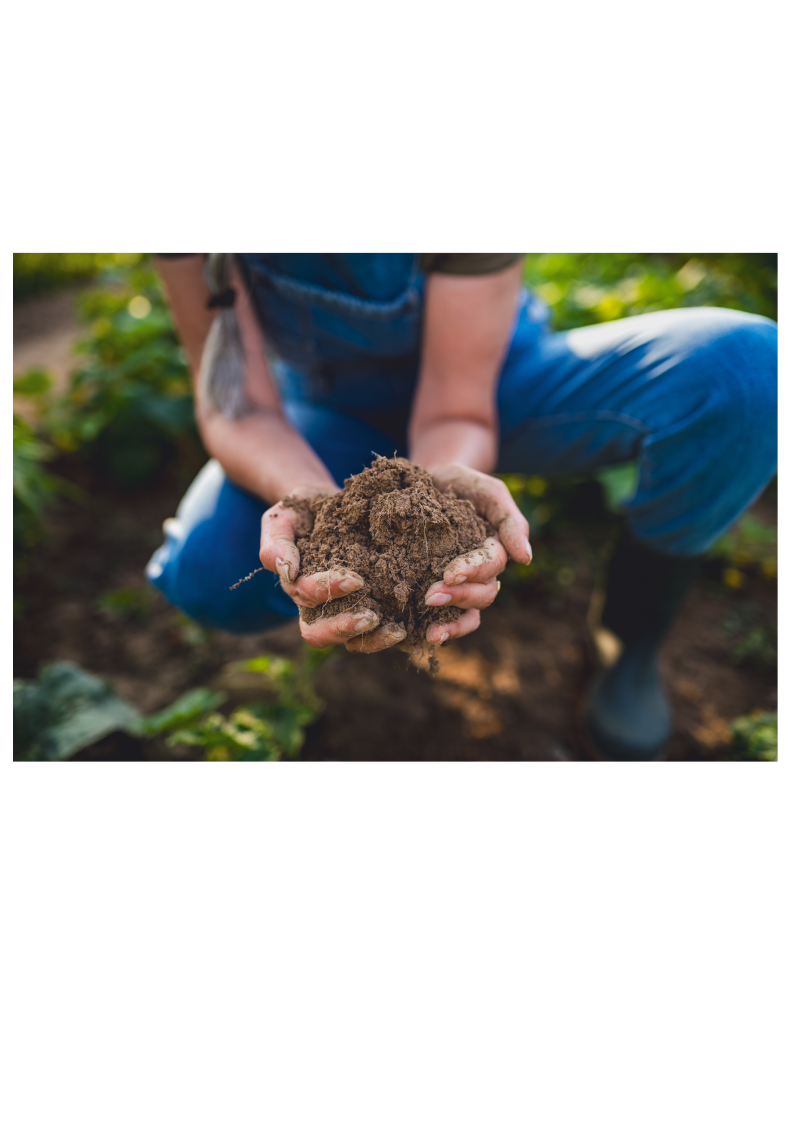
Yann Boulestreau initiated a working group of farmers focused on regenerative agriculture, with a clear objective: to develop more sustainable farming practices that increase organic matter in the soil, store more carbon, and make farming systems more resilient to drought. This is especially important in a region with sandy soils that retain little water, while the future of irrigation is becoming increasingly uncertain.
Within this group, farmers work together on practices such as cover cropping, aiming to sow earlier and with greater diversity in order to produce more biomass and bring life back into the soil. The initiative is not only about agricultural techniques, but also about learning together through real-life experience, including both successes and failures.
One of the most inspiring dimensions of this initiative is the strong emphasis on trust between peers. Yann explains that he set very clear rules from the start: participants must be practitioners, the group is not a place to sell products or machinery, and exchanges must remain focused on practical farming experience. This creates a safe space where farmers can honestly discuss what works and what does not. This co-construction is essential because it allows people to share field-based knowledge without competition or performance.
This initiative also shows that young people have a real role to play in climate transition. Two farmers under 30 and one student not yet fully established in farming are part of the group. According to Yann, these young participants bring strong engagement, knowledge gained from both study and practice, and the ability to apply alternative farming methods directly in the field. Their involvement shows that youth are not only affected by environmental change, but are already contributing to solutions.
Yann also highlights an important lesson: for this kind of initiative to succeed, it must remain highly practical and field-oriented. People need to meet around real practices, visit farms, go outside, observe, exchange, and learn together. The role of the facilitator is not to impose knowledge from above, but to create the conditions for experience, research, and practical know-how to meet. This is where collective intelligence becomes powerful.
Through this campaign, Green Seeds wants to make such examples visible to show that climate action can be local, collaborative, and replicable. Raising awareness also means sharing practices that already work, and encouraging more young people, youth workers, and local actors to draw inspiration from them.